A casino reopening is just a licensed gaming venue switching the lights back on after a closure. That is the clean definition, and it falls apart almost immediately once you look at a real case. Reopening a gaming floor means re-earning a licence, re-certifying machines, rehiring specialist staff, settling whatever liabilities piled up during the dark months, and persuading customers who found something else to do in the meantime to come back.
The reconstruction at San Martin, in Argentina’s Mendoza province, is a useful example to walk through, because it contains almost every variable operators argue about: fire damage, a hard deadline, a large capital commitment, a commercial expansion bolted onto the gaming hall, and a labour dispute running alongside the build.
From a March fire to a December target: the Grupo Kristich timeline
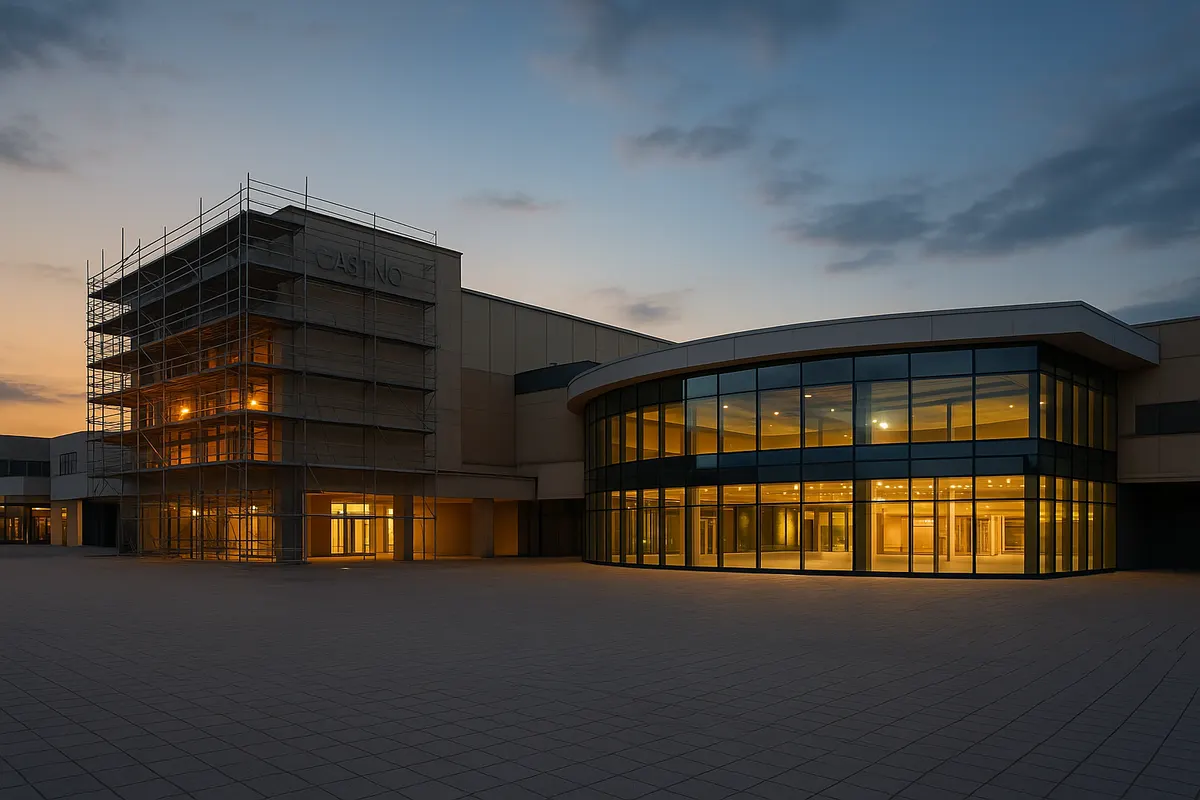
In March 2026, a fire destroyed the casino at San Martin and damaged part of the attached shopping centre. Reports at the time described total losses on the gaming side. Six months later, the Tótem Boulevard complex was in active reconstruction, with the operator targeting a return to activity in the first half of December 2026.
The works are being driven by Grupo Kristich, with an investment put at roughly ARS 18 billion to ARS 20 billion. The rebuild is not a like-for-like restoration. It adds about 1,700 square metres of covered space to reach a total of 7,000 square metres, brings the gaming hall annex back, and roughly doubles the retail component from 12 units to around 30. Food and beverage areas, pedestrian space and the complex’s medical clinic are all part of the reopening plan.
| Element | Before the March 2026 fire | Planned on reopening |
|---|---|---|
| Covered floor area | About 5,300 m² (7,000 m² less the 1,700 m² extension) | 7,000 m² |
| Retail units | 12 | Around 30 |
| Gaming hall | Destroyed by fire | Gaming room annex returns |
| Medical clinic | Closed | Reopening |
| Reported investment | — | ARS 18–20 billion |
| Target date | — | First half of December 2026 |
The uncomfortable part of the wider provincial picture: separately from the fire, a provincial restructuring of table games ended traditional table gaming at Casino de Mendoza, a measure that affected 81 employees, with voluntary exits offered to other staff. Local reporting also flagged outstanding tax liabilities. So the project is simultaneously an expansion and a restructuring, which is far more typical of casino revivals than press releases suggest.
How a casino reopening actually gets done
Strip out the local detail and most reopenings move through the same four workstreams, usually in parallel rather than in sequence: regulatory clearance, physical and technical rebuild, staffing, and demand recovery. The order matters less than the dependencies. You cannot certify a gaming floor that is not finished, and you cannot train dealers for a floor plan nobody has approved yet.
Regulatory compliance and licensing
Gaming licences in Argentina are granted and policed at provincial level, so a Mendoza venue answers to Mendoza’s gaming authority rather than a national regulator. That matters for timing. A licence is typically tied to specific premises, an approved layout, surveillance coverage and an authorised number and type of machines and tables. Change the building and you are usually changing the licence file.
After a fire, expect re-inspection of the gaming area, fresh sign-off on fire suppression and emergency exits, and recertification or replacement of slot machines, since heat, smoke and water damage make it hard to vouch for the integrity of a cabinet’s hardware or its random number generator. Anti-money-laundering procedures, cash handling controls and player identification processes also have to be demonstrably live from day one, not promised. Unresolved tax liabilities do not help a file either; provincial treasuries and gaming regulators tend to share information, and arrears are an easy reason to slow an approval.
Infrastructure and technology updates
A forced rebuild is the cheapest moment an operator will ever get to modernise, because the walls are already open. In practice that means newer machine cabinets, updated jackpot and floor management systems, better network cabling, cashless or ticket-in/ticket-out handling where the rules allow it, and surveillance that meets current standards rather than the standard in force when the venue was first licensed.
It also means rethinking the mix. San Martin’s plan leans heavily on non-gaming square metres, with retail units more than doubling and gastronomy, pedestrian areas and a clinic in the envelope. That is a deliberate hedge. Gaming revenue per square metre is volatile and politically exposed; rent from retail tenants and footfall from a medical clinic are not.
Staffing and training requirements
This is where reopenings get painful. Dealers, floor supervisors, cage staff and compliance officers are specialist roles, and in many jurisdictions individual employees need their own licence or registration. Lay that workforce off during a closure and a chunk of it does not come back, because experienced croupiers find other work.
Mendoza shows the pattern in its rawest form: the end of table games at Casino de Mendoza under provincial restructuring affected 81 employees, with voluntary exits offered alongside it, against a San Martin reopening that will need a trained floor in December. Even where headcount returns, every hire needs retraining on the new layout, the new systems, AML reporting, age verification and responsible gambling procedures. Budget-wise, the training bill is small; the scheduling risk is not.
What this says about Argentina’s casino industry
Capital commitment is the signal worth reading. Argentine peso figures are hard to compare across years given inflation, so the number itself tells you less than the decision behind it: an operator choosing to rebuild and expand a provincial venue rather than take the insurance outcome and walk away. You do not add 1,700 square metres to a venue you expect to be structurally unprofitable.
The second signal is the shape of the investment. Argentina’s gambling market is regulated province by province, and a growing number of provinces have licensed online gaming in recent years. That changes the job description of a mid-size provincial casino. It is no longer the only place to place a bet in the area, so the rebuild treats gaming as one anchor inside a mixed-use complex rather than the whole proposition.
The third signal is less flattering. Labour disputes and tax arrears appearing in the same story as a multi-billion-peso rebuild point to an operating environment where cash flow discipline and provincial fiscal pressure are both tight. Analysts reading San Martin as proof of a healthy market should read the liabilities column too.
Where reopenings stall
Most of the friction in a casino market recovery is predictable, which is why it is worth listing plainly:
- Online substitution. Customers who moved to licensed online casinos and sportsbooks during the closure have no particular reason to move back. Convenience is sticky.
- Changed habits. Reopened venues often find weekday footfall weaker and spend concentrated on weekends and events, which makes staffing rosters harder to plan.
- Fixed costs in an inflationary economy. Energy, security, insurance and maintenance on a 7,000 square metre complex run whether the gaming floor is busy or not.
- Licensing timelines outside the operator’s control. A missed inspection window can push an opening past the trading season it was built for. December targets in the southern hemisphere exist for a reason.
- Workforce reconstruction. Rehiring and retraining after job losses costs goodwill as well as money, and labour conflict can delay an opening date directly.
- Insurance and legacy liabilities. Settlement disputes and tax arrears compete with the construction budget for the same cash.
The wider pattern behind land based casino revival
San Martin fits a shape visible across markets since the wave of pandemic-era closures: brick and mortar casinos that come back tend to come back smaller on pure gaming and larger on everything around it. Retail, dining, hospitality and leisure space absorb the risk that used to sit entirely on the gaming floor. Table games are frequently the casualty, because they carry the highest labour cost per position, while machine floors return faster.
Two other patterns are worth tracking. First, revivals are usually led by operators who control the real estate, since a landlord has a reason to rebuild that a pure gaming tenant does not. Grupo Kristich rebuilding an entire boulevard complex, clinic included, is that logic in action. Second, reopening announcements cluster where regulators have settled their online framework, because operators can finally price land-based demand against a known online market rather than an unknown one.
So what does a casino reopening indicate? Less about gambling demand than people assume, and more about capital confidence in a specific location and a specific regulator. The honest read on San Martin is that one operator believes a Mendoza complex with doubled retail and a returning gaming annex will pay back ARS 18–20 billion, while the 81 employees affected by the end of table games at Casino de Mendoza and the provincial tax authority are still waiting on the other side of the same provincial picture. Both facts belong in the analysis.
Frequently asked questions
How do casinos reopen after closure?
They rebuild or refit the premises, re-engage the gaming regulator for inspection and licence amendments, recertify or replace gaming machines, re-establish AML and cash controls, then hire and train a licensed floor team before marketing a reopening date.
Why are casinos reopening now?
Usually because a specific trigger makes it viable: insurance or redevelopment funding after damage, a settled provincial or national regulatory framework, or a mixed-use plan that spreads risk across retail and hospitality instead of relying on gaming revenue alone.
What challenges do reopening casinos face?
Competition from licensed online operators, softer weekday footfall, high fixed operating costs, regulatory timelines they do not control, and the cost of rebuilding a trained workforce after job losses.
What does the San Martin case tell other operators?
That a gaming hall is increasingly one tenant inside a commercial complex, and that legacy liabilities, labour relations and licence conditions shape the opening date at least as much as construction does.
Gambling always carries a built-in house edge and should be treated as paid entertainment, not income. Operators and analysts reading market recovery data should pair growth figures with the player protection tools, deposit limits and self-exclusion options that licensed venues are required to provide.