On a Tuesday morning in Madrid, a compliance officer at a licensed online operator opens a file she updates every quarter: a list of rules that have changed, rules that are about to change, and rules a court has suspended. The third column is the one that keeps growing. That file is, in miniature, the reason Spain’s private gaming sector is sitting down in public to talk about regulation.
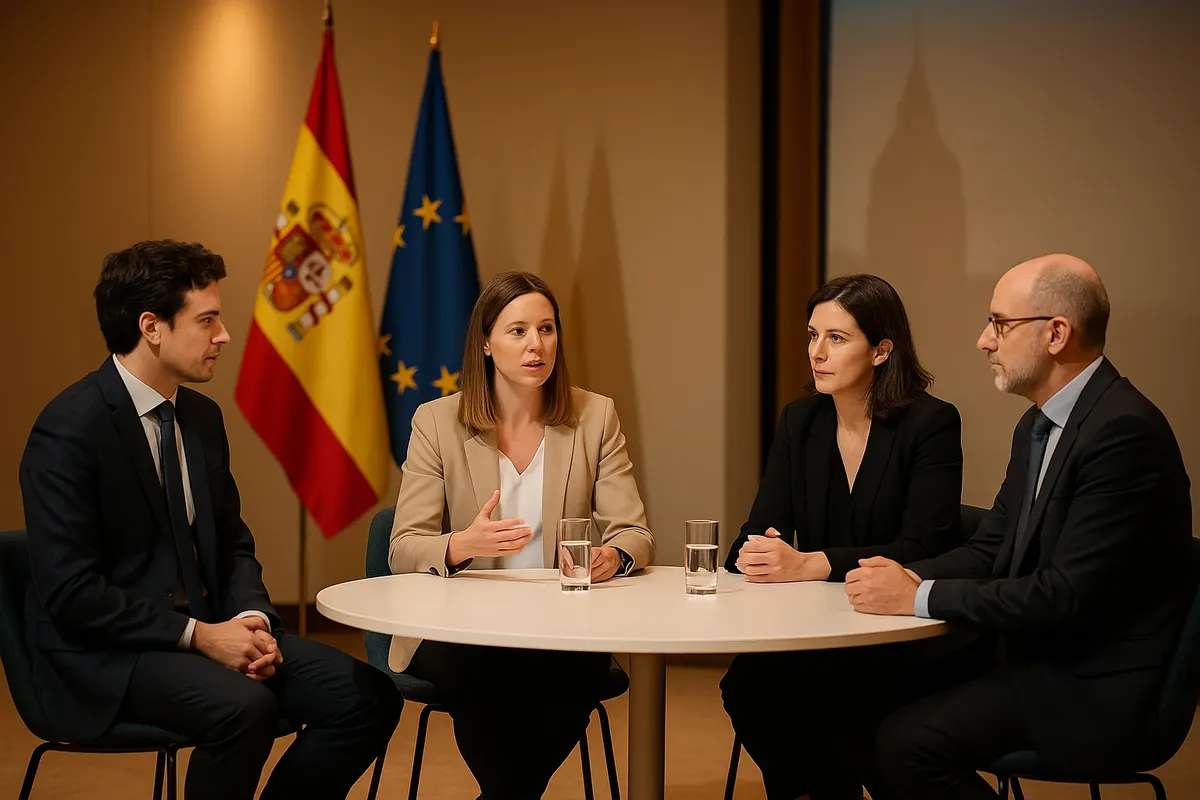
On 14 October 2026 at 12:30, the Consejo Empresarial del Juego (CEJUEGO), better known as CeJuego, holds the first edition of its Foro CeJuego 2026. The event doubles as the launch of the latest Juego y Sociedad report and, according to the association, as a debate on the main regulatory and legislative challenges facing the industry. For anyone tracking Spain gambling regulation, it is a useful marker of where the conversation has moved to.
Who is organising the forum, and why now?
CeJuego is the employers’ association representing Spain’s private gambling sector, around 70% of it by its own account. Its annual Juego y Sociedad report has been its main public-facing document, and this year the association has changed how it presents it: instead of a straight report launch, the format combines an interview with a round table bringing together experts from the regulatory sphere and the industry itself.
Alejandro Landaluce, CeJuego’s director general, framed the redesign as a shift in how the sector explains itself to the public. “It is the presentation of Juego y Sociedad, but in a different format, with a round table where we will address highly topical issues on regulation and other matters,” he said. One of the stated objectives is to “open an interesting debate that allows concepts to be clarified within public opinion and within the sector.”
That second half of the sentence is the tell. Spain’s gambling debate has been unusually polarised, and industry bodies have spent years arguing that public perception and regulatory drafting have drifted apart from each other. CeJuego said the speakers and the full programme would be announced in the weeks before the event, so the agenda in detail is not public yet.
What regulatory challenges will Spain actually address?
The forum’s published remit is broad: the principal regulatory and legislative challenges facing the sector. Spain’s current rulebook makes it fairly clear which files those are. Online gambling is governed nationally by Law 13/2011 and supervised by the Dirección General de Ordenación del Juego (DGOJ), with two later pieces of secondary legislation doing most of the heavy lifting on advertising and on player protection.
| Instrument | What it covers | Why it is contested |
|---|---|---|
| Law 13/2011 | National licensing regime for online gambling, DGOJ powers, sanctions | Licence categories and renewal mechanics date from a pre-app, pre-live-casino market |
| Royal Decree 958/2020 | Commercial communications: ad time windows, sponsorship limits, bonus restrictions | Spain’s Supreme Court annulled several provisions in 2024 as exceeding the parent law, leaving parts of the regime unsettled |
| Royal Decree 176/2023 | “Safer gambling environments”: behavioural monitoring, risk markers, intervention duties | Operators must detect and act on intensive play, with limited guidance on what counts as enough |
| Regional land-based rules | Betting shops, arcades, premises licensing across 17 autonomous communities | Seventeen parallel frameworks, several tightened independently of national policy |
Player protection gaps
The safer-environments decree moved Spain from rules about advertising to rules about behaviour. Licensed operators are expected to monitor how customers actually play, identify markers of intensive or risky play, and intervene rather than wait for a complaint. Spain also operates a national self-exclusion register, so a ban requested once applies across licensed sites.
The gap is in execution. Detection thresholds, what an intervention must consist of, and how supervisors judge whether one worked are the practical questions, and they are exactly the kind of thing a panel of regulatory specialists gets asked. Add the unlicensed sites that sit outside all of it, and you have the file that most responsible gambling policy discussions in Spain keep returning to.
Licensing framework updates
Spain’s online licences are issued nationally in general categories (betting, other games, contests) with singular licences underneath them. The structure has held up, but the market it was written for looked different. Live dealer content, crash games, fast-cycling slot mechanics and app-first distribution all arrived after the architecture was set. Each new product raises the same question: which licence does it sit under, and what technical and reporting standards apply?
Cross-border operator issues
There is no harmonised EU gambling market. An operator licensed in Malta cannot serve Spanish players on that basis; it needs a Spanish licence, Spanish technical systems reporting into the DGOJ, and Spanish compliance. The one meaningful crack in the national wall is shared online poker liquidity, where Spain pools player pools with France, Italy and Portugal under a multilateral agreement. Everything else, from know-your-customer standards to advertising, is national. Online gambling compliance in practice means running the same business four or five times over with different rules in each.
How would these changes affect players?
Mostly in ways that feel like friction before they feel like protection. The direction of travel in Spain points to more identity verification up front, more visible spending and session information, more prompts when play intensity rises, and easier access to deposit limits, cool-off periods and self-exclusion. Bonus offers stay narrower than in lightly regulated markets, and that is deliberate: welcome promotions were restricted precisely because they recruit new players at the moment they understand the product least.
What tighter regulation does not change is the maths. A game’s RTP and the house edge that mirrors it are fixed by design, so a 96% RTP slot carries a 4% house edge whether it is played on a licensed Spanish site or anywhere else. Regulation makes outcomes verifiable, payouts enforceable and limits available. It does not make gambling profitable over time, and no rulebook claims to.
The practical advantage of playing within a licensed framework is recourse. Certified RNG testing, audited game behaviour, a regulator that can sanction, and a self-exclusion register that actually binds are things unlicensed sites cannot offer, no matter how generous the offer on the landing page looks.
What it costs operators in the Spanish betting market
Compliance in Spain is a fixed cost that scales badly for small operators. Behavioural monitoring under the safer-environments rules means data infrastructure, defined risk models, staff to review flags and documentation to prove intervention happened. Advertising rules constrain the cheapest acquisition channels, which pushes marketing spend toward retention and affiliate quality rather than volume. Technical systems must report into the regulator in prescribed formats.
The combined effect on the Spain betting market has been consolidation. When fixed compliance costs rise and acquisition gets harder, scale wins, and the operators best placed to absorb new requirements are the ones already running multi-market compliance teams. Legal uncertainty compounds it: after the Supreme Court trimmed parts of the 2020 advertising decree, operators had to plan marketing around a regime whose edges were being redrawn in court.
Is Spain an outlier, or is this the European pattern?
It is the pattern. Across Europe the same four levers keep getting pulled: advertising restrictions, affordability and behavioural monitoring, central self-exclusion registers, and harder enforcement against unlicensed supply. Germany rebuilt its market around a federal regulator and strict product limits. The Netherlands layered on deposit limits and advertising curbs after opening its market. Belgium went furthest on advertising. The UK’s licensing review pushed the industry toward checks on customer risk.
Because the Court of Justice of the European Union has consistently left gambling licensing to member states on public-interest grounds, convergence happens by imitation rather than by directive. A measure that survives scrutiny in one market tends to appear in the next one’s consultation paper. That is why an industry forum in Madrid is worth reading outside Spain: the arguments rehearsed there, about proportionality, enforcement capacity and where the boundary of protection sits, are the arguments every European market is having.
What to watch between now and the forum
Three things, in order. First, the speaker list and programme CeJuego said it would publish in the weeks beforehand, which will show whether regulators and public-health voices take part or whether this stays an industry conversation. Second, the Juego y Sociedad data itself, since the report is the evidence base the sector brings to negotiations. Third, which specific files the round table names, because a forum is an agenda-setting exercise, not a legislative one. It produces positions and priorities, not rules. The rules come later, through the DGOJ and the ministry, and usually through consultation.
If you play on licensed sites, the useful habit regardless of what any forum concludes is to set your own deposit and loss limits before you need them, and to use the cool-off and self-exclusion tools that Spanish licensees are required to provide. Help for problem gambling is available through national support services; gambling should be treated as paid entertainment with a known cost, never as a way to make money.